|
Welcome to our October Newsletter!
This month, we’re exploring one of the biggest topics shaping universities today: AI in Higher Education. As AI becomes increasingly integrated into student learning, our latest blog examines how UK government and university policies are responding, highlighting the need to balance innovation with human judgement, ethics, and academic integrity. You’ll find clear insights, institutional examples, and practical strategies for responsible integration of AI in teaching and assessment.
|
We’ve also launched a comprehensive classroom lesson that helps students explore the opportunities, risks, and ethical dimensions of generative AI. Through interactive reading, writing, and discussion tasks, learners discover how to use AI responsibly and interpret institutional frameworks like the AI Traffic Light System. Go here.
|
As a special feature, we’re offering a FREE AI Student Checklist, guiding students step by step on how to use AI safely and ethically before, during, and after creating their work. Go here.
|
The AEUK Team
Newsletter #172
|
|
|
|
Generative AI In Higher Education: Opportunities, Risks and Assessment Design
|
|
RESEARCH: This overview was created by analysing current guidance and evidence from the UK Government alongside policies and practice papers from leading UK universities: Glasgow, Leeds, Reading, Sussex, Manchester, Edinburgh, King’s College London, Leicester, Liverpool and Newcastle. (This is only part of the article: Full Article)
|
|
What is Generative AI?
|
|
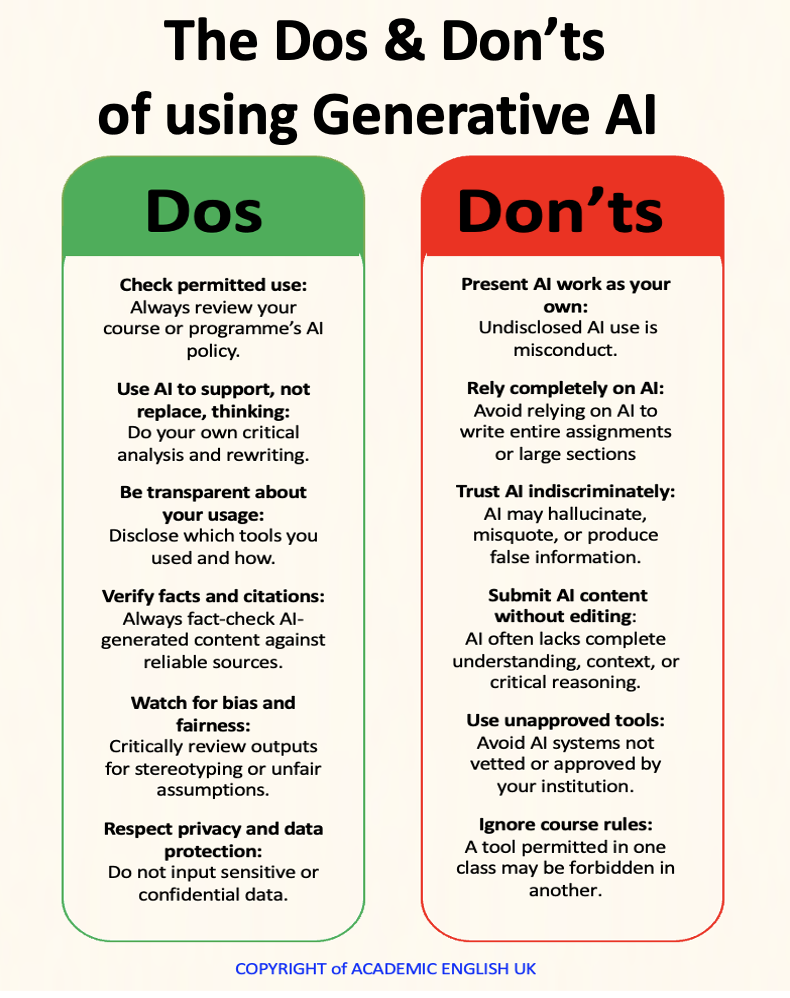
Generative artificial intelligence (Gen AI) in education refers to tools such as ChatGPT, Google Gemini, Microsoft Copilot, Deep Seek, Grammarly and Midjourney that create new content including text, images, code, and simulations to enhance and personalise teaching and learning. These technologies can support automated feedback, lesson design, adaptive tutoring, and the creation of realistic scenarios. However, they also carry risks such as spreading misinformation, raising ethical concerns, and weakening critical engagement when used without careful evaluation (1-5).
|
|
|
|
Limitations and Risks of Gen AI in Education
Generative AI provides opportunities such as personalised learning and content creation, but it also poses risks including misinformation, bias, and privacy concerns, which require responsible and critical use (2-5).
|
- Reliability and Accuracy
- Bias and Fairness
- Academic Integrity
- Data Privacy and Compliance
- Ethical and Social Concerns
|
More detailed information can be found here.
|
|
|
|
Designing Gen AI Resilient Assessments
AI resilient assessment design combines selective invigilation, live components, contextualised and process-based tasks, collaboration, ethical judgment, experiential learning, and guided AI use to promote integrity, critical thinking, and authentic engagement (6–8).
|
- Invigilated and On-Campus Components
- Contextual and Localised Assessment Tasks
- Interlinked and Developmental Assessment
- Higher-Order Thinking and Critical Engagement
- Authentic and Scenario-Based Tasks
- Incorporation of AI within Assessment
More detailed information can be found here.
|
|
|
|
The Gen AI Traffic Light System for Assessment
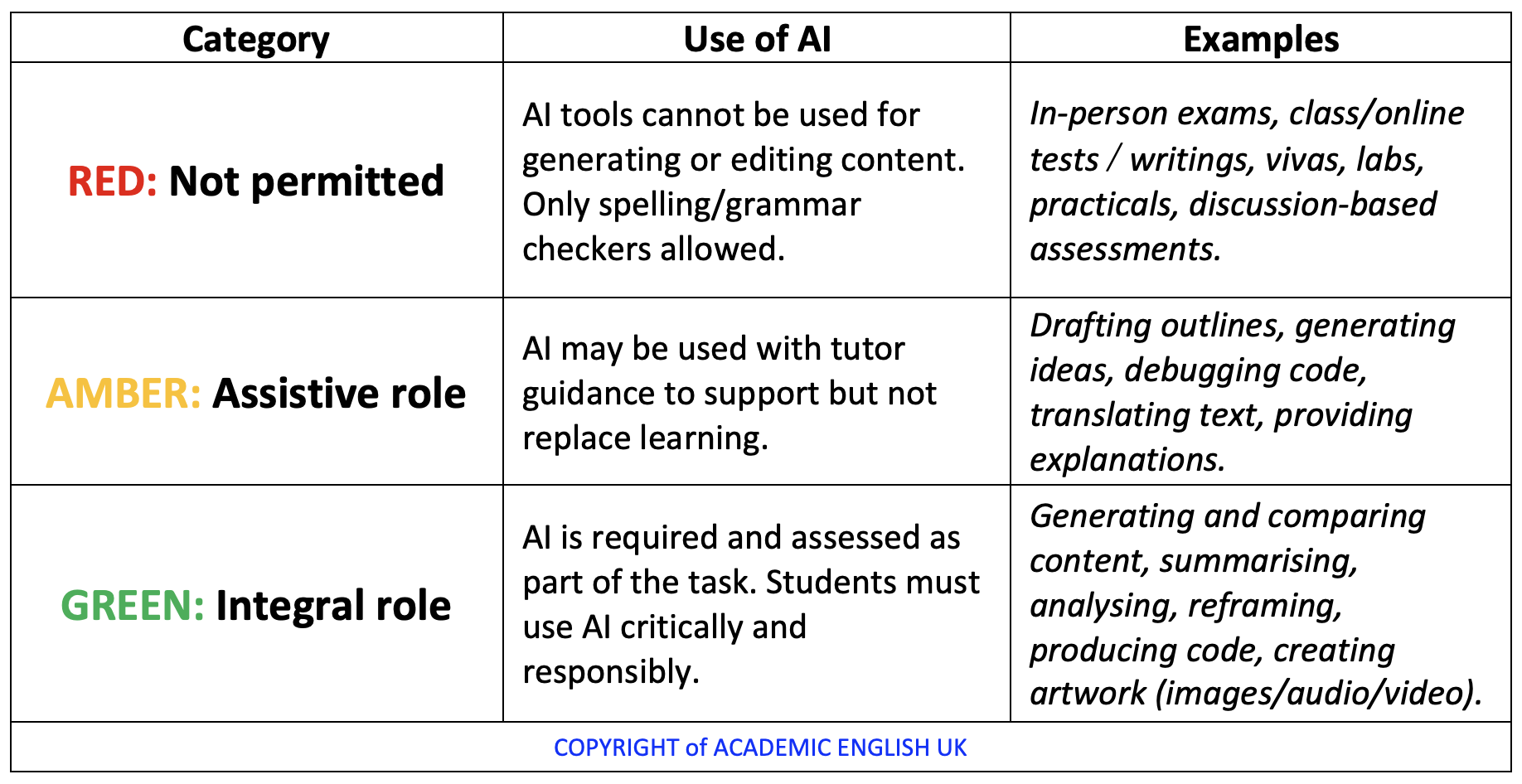
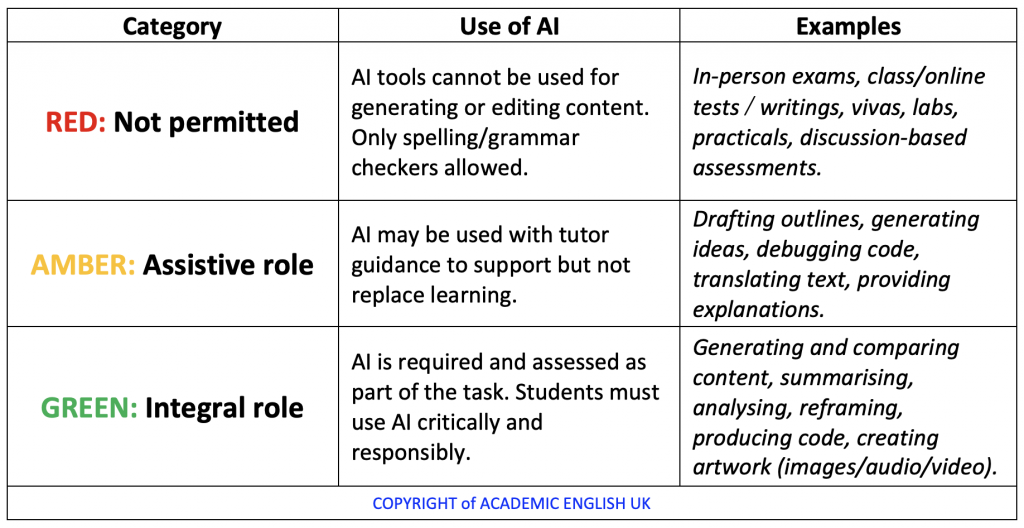
The Gen AI Traffic Light System sets clear policy on academic integrity by defining when AI use is prohibited (red), allowed in an assistive role (amber), or required as part of the assessment (green). It ensures students use AI responsibly, supporting learning without undermining originality, fairness, or academic standards (6,9).
|
|
|
|
|
|
|
Gen AI in English Language Courses
Decisions about AI use in English language courses must align with each course’s pedagogical aims and learning outcomes, balancing language development with responsible technology use. As EAP is highly skills-based, institutions face complex questions about how far students may rely on AI tools for translation, paraphrasing, or editing, and how tutors can ensure authorship and fairness in an evolving AI landscape (6-10).
|
Possible solutions include:
|
- Reintroduction of Traditional Methods: Reinstate pen-and-paper classroom activities such as defining terminology, paraphrasing, summarising, note-taking, and vocabulary development.
- Defining Acceptable AI Use: Establish clear parameters for the permissible use of generative AI within language learning contexts.
- Assessing Student Comprehension: Use oral assessments such as vivas, defences, or on-campus sign-off methods to verify students’ understanding.
- Institutional AI Policy Framework: Implement an institutional AI policy with an “AI Traffic Light” system defining acceptable and prohibited uses.
- Data Protection and Privacy Compliance: Promote awareness of data security and ensure full adherence to GDPR and UK data protection regulations.
- AI Literacy and Risk Awareness: Integrate AI training into the curriculum to teach students its limits, ethics, and risks of over-reliance.
More detailed information can be found here.
|
|
|
|
Downloads
|
|
|
AN INTRODUCTION TO AI IN THE CLASSROOM
|
This lesson introduces students to the key opportunities, risks, and ethical considerations of using generative AI in higher education. Through reading, writing, and discussion tasks, students learn how to apply AI responsibly, evaluate its limitations, and understand institutional policies such as the AI Traffic Light System for academic integrity. EXAMPLE Level ***** [B1/B2/C1] INFORMATION WEBPAGE
|
|
|
|
|
|
|
|
|
|
|
|
Oct 2025. AI in Higher Education AI in the classroom. Generative AI (Gen AI) is transforming higher education by enabling more personalised, efficient, and accessible learning, while..
|
|
|
|
|
|
Aug / Sept 2025. "English for Art" refers to specialised English language instruction that develops vocabulary, grammar, and communication skills relevant to visual arts, art history...
|
|
|
|
|
|
British vs American English
|
|
|
July 2025 British Vrs American English. The main differences between British (BrE) and American (AmE) English are three main areas: 1) Vocabulary 2) Spelling 3) Pronunciation...
|
|
|
|
Academic Research Report Writing
|
|
|
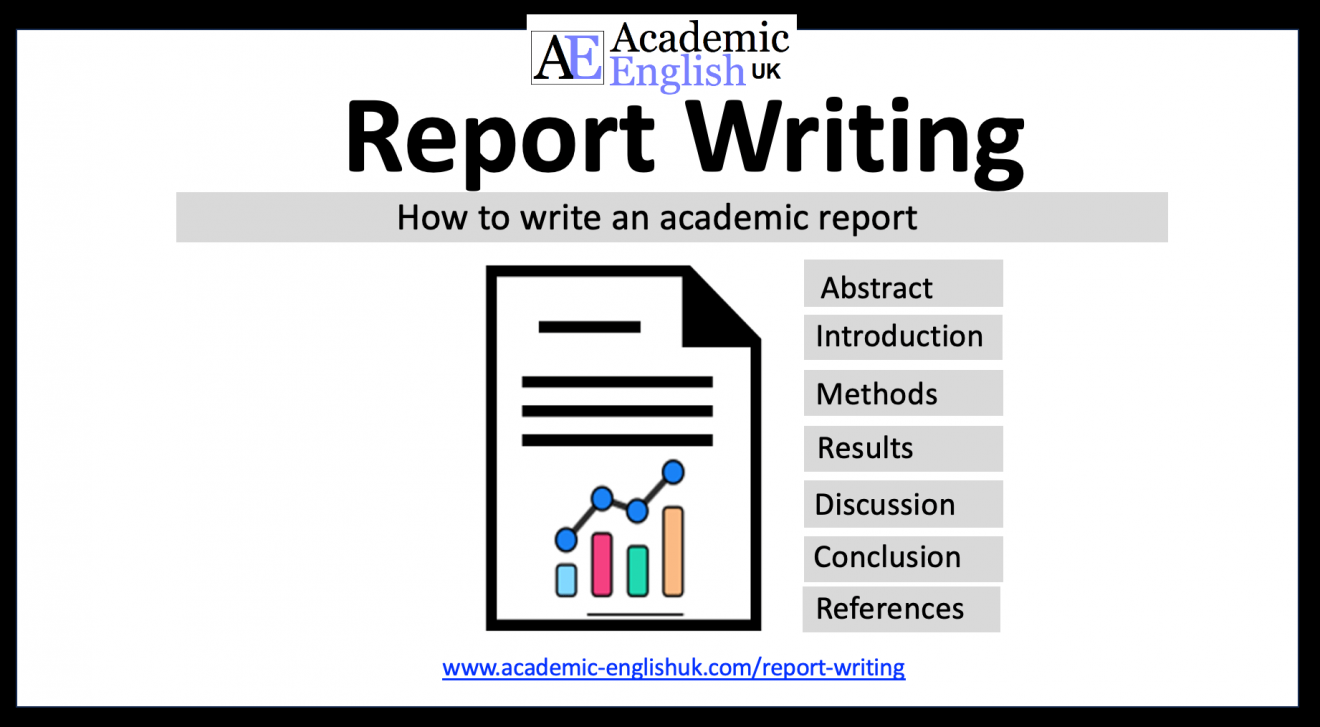
April / May 2025. Academic Research Report Writing. An academic report is a structured document that presents information, analysis, and findings on a specific topic or research …
|
|
|
|
|
|
Error Correction in Writing
|
|
|
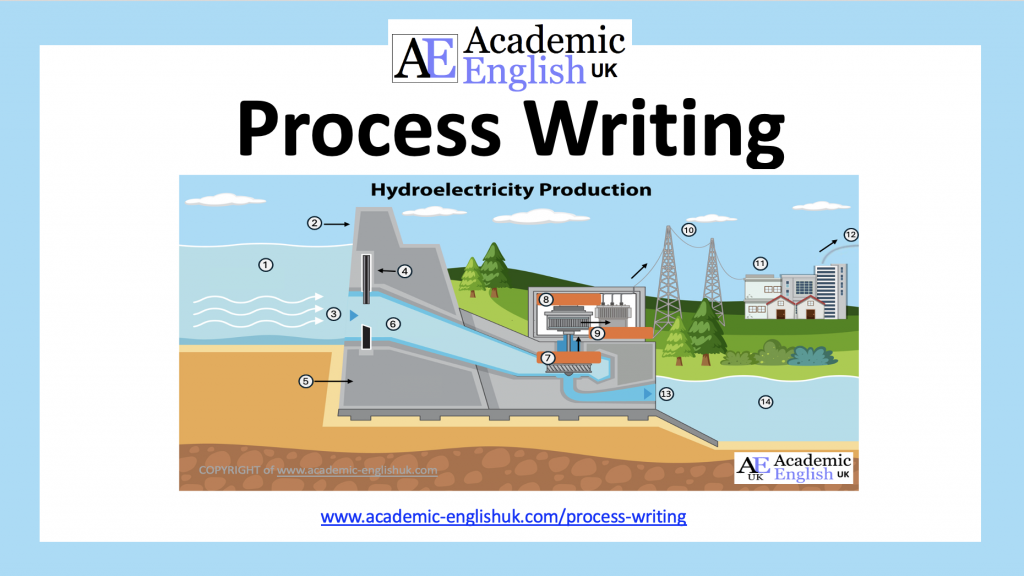
March 2025. Process writing provides a step-by-step description of how something operates or is produced. The explanation includes a range of writing skills: Describe the process in detail...
|
|
|
|
|
|
Error Correction in Writing
|
|
|
Jan & Feb 2025. Error Correction in Writing. These are a selection of lessons that focus on one specific error (prepositions, articles, tenses, wrong word, relative clauses, etc..) in a short ...
|
|
|
|
|
|
Dec 2024 Over the last 12-months of 2024 we created 70 new resources from error correction texts to critical thinking exercises. New releases for 2024 Writing Lessons, vocabulary ...
|
|
|
|
|
|
Dialogic Feedback in Academic Writing
|
|
|
Nov 2024 “Dialogic feedback is a way of providing feedback that involves a conversation between a teacher and student, rather than a one-way transmission of information. It's a collaborative ...
|
|
|
|
Want more BLOG articles? Go here for all our 2025 blogs...
|
|
|
|
|
|