|
|
|
This month, we’re delighted to introduce our Academic Source-Based Writing Tests; a new collection of unseen assessments designed to assess students’ ability to read, analyse and respond to multiple academic sources without the use of AI tools. Each test presents students with three contrasting sources and asks them to synthesise information, evaluate ideas and produce a focused academic response within a set time.
|
The assessments provide a more AI-resistant approach to academic writing assessment, as students must work directly with unseen source material during the test rather than relying on pre-prepared content or AI-generated responses. Suitable for learners from B2 to C2, these ready-to-use tests are ideal for diagnostic, formative or summative assessment. Try our free sample test on mobile phones and student learning and see how the assessments work for yourself. Simply scroll down and start exploring!
|
IMPORTANT: These tests are available exclusively through Institutional Membership. This means they are protected from student access and can be used as secure formative or summative assessments.
|
The AEUK Team
Newsletter #185
|
|
|
|
What are academic source-based writing tests?
The tests require students to read three contrasting sources and produce an academic response that summarises information, compares viewpoints, evaluates evidence and develops a balanced argument. The test allows teachers to assess students’ development of integrated reading-to-writing skills across different topics using the CEFR criteria from B2-C2 levels.
|
|
Purpose and assessment focus
|
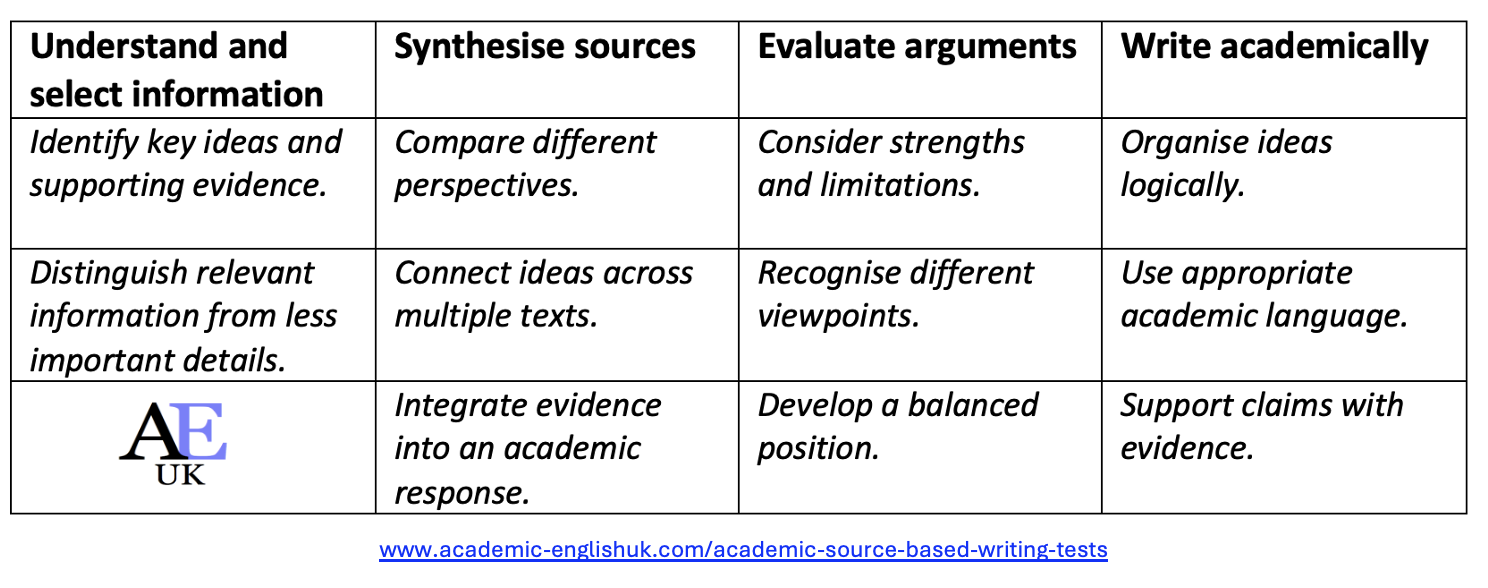
The assessment is designed to measure key academic skills required for university study, where students are expected to combine information from multiple texts and construct evidence-based arguments. The test assesses students’ ability through the CEFR descriptors of:
|
|
|
|
Using the tests across B2–C2 levels
|
|
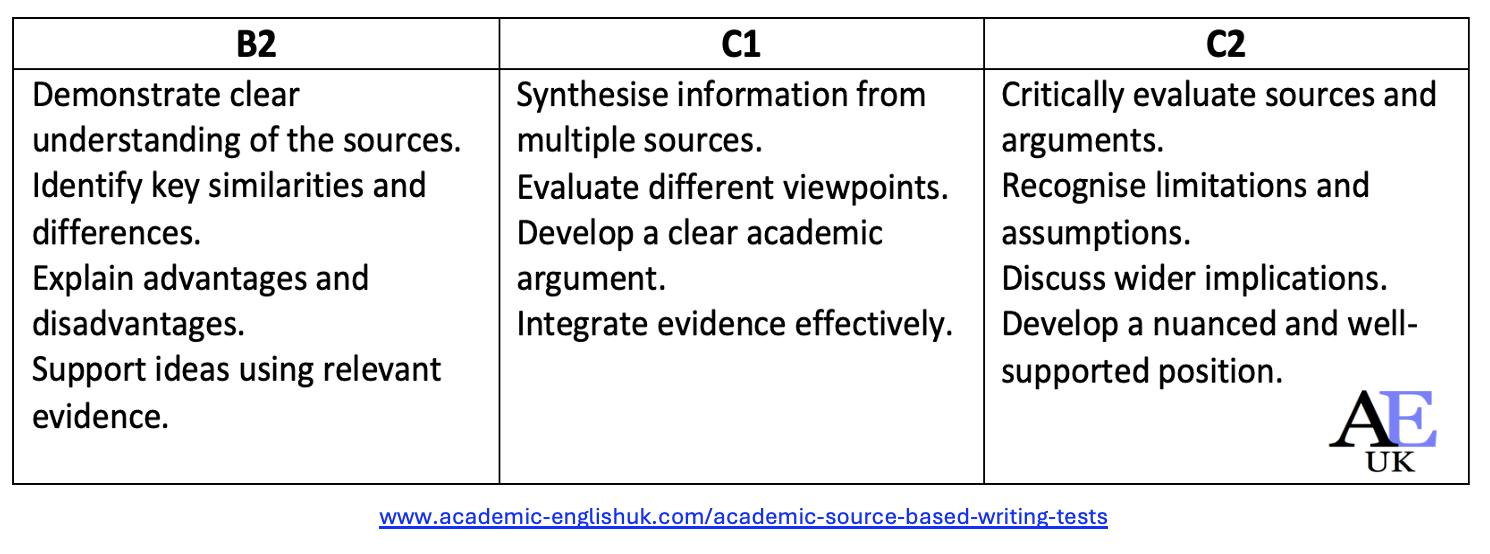
The test uses the same task format and are suitable for B2, C1 and C2 learners. The difference between levels is reflected in the quality and depth of students’ responses. The following guide is what is expected at each level.
|
|
|
|
|
|
|
Sample Download
|
|
|
|
|
SAMPLE: Smart Phones and Student Learning
|
This unseen integrated reading-to-writing assessment requires students to read three contrasting academic sources and use the information to produce a 300–500-word academic response. The test includes a clear test brief, student instructions, three contrasting sources, and assessment criteria and marking guidance. Students have 60 minutes to read the sources, make notes, and write their response Level: ***** [B2/C1/C2] INSTITUTIONAL MEMBERSHIP
|
|
|
|
|
|
|
|
5x Securely Protected Downloads
|
|
|
|
IMPORTANT: These tests are available exclusively through Institutional Membership. This means they are protected from student access and can be used as secure formative or summative assessments.
|
|
|
|
TEST 1: Artificial Intelligence in Higher Education
|
This unseen integrated reading-to-writing assessment requires students to read three contrasting academic sources and use the information to produce a 300–500-word academic response. The test includes a clear test brief, student instructions, three contrasting sources, and assessment criteria and marking guidance. Students have 60 minutes to read the sources, make notes, and write their response. Level: *****[B2/C1/C2] INSTITUTIONAL MEMBERSHIP
|
|
|
|
|
|
TEST 2: Social Media and Academic Research
|
This unseen integrated reading-to-writing assessment requires students to read three contrasting academic sources and use the information to produce a 300–500-word academic response. The test includes a clear test brief, student instructions, three contrasting sources, and assessment criteria and marking guidance. Students have 60 minutes to read the sources, make notes, and write their response. Level: *****[B2/C1/C2] INSTITUTIONAL MEMBERSHIP
|
|
|
|
|
|
TEST 3: Online Learning and Face-to-Face Teaching
|
This unseen integrated reading-to-writing assessment requires students to read three contrasting academic sources and use the information to produce a 300–500-word academic response. The test includes a clear test brief, student instructions, three contrasting sources, and assessment criteria and marking guidance. Students have 60 minutes to read the sources, make notes, and write their response. Level: *****[B2/C1/C2] INSTITUTIONAL MEMBERSHIP
|
|
|
|
|
|
TEST 4: University Students and Part-Time Employment
|
This unseen integrated reading-to-writing assessment requires students to read three contrasting academic sources and use the information to produce a 300–500-word academic response. The test includes a clear test brief, student instructions, three contrasting sources, and assessment criteria and marking guidance. Students have 60 minutes to read the sources, make notes, and write their response. Level: *****[B2/C1/C2] INSTITUTIONAL MEMBERSHIP
|
|
|
|
|
|
TEST 5: The Purpose of University Education
|
This unseen integrated reading-to-writing assessment requires students to read three contrasting academic sources and use the information to produce a 300–500-word academic response. The test includes a clear test brief, student instructions, three contrasting sources, and assessment criteria and marking guidance. Students have 60 minutes to read the sources, make notes, and write their response. Level: *****[B2/C1/C2] INSTITUTIONAL MEMBERSHIP
|
|
|
|
|
|
|
|
Institutional Membership
|
These are logo-free Microsoft Word documents for universities, educational institutes or English language schools. Institutional Membership provides full access to 550 resources with an estimated value of £1000.
|
|
1) Use /share our materials with unlimited teachers & unlimited students.
|
|
2) Create courses and printable / digital course booklets.
|
|
3) Put our materials on Electronic Learning Environments.
|
|
4) Add your own signage and adapt the materials in anyway you would like.
|
|
5) Share Academic English UK login details with up to 20 teachers.
|
|

|
|
|
|
|
|
|
Recent Blog Articles
|
|
|
TED Talk AI Listening Lessons
|
|
|
July 2026. AI TED Talk Listening Lessons. TED Talk Listening Worksheets develop students' academic listening and note-taking skills through an authentic TED Talk...
|
|
|
|
|
|
June 2026. These academic speaking tests help students develop fluency, confidence, and critical thinking through a range of AI-related topics, including education, social media...
|
|
|
|
|
|
Common Idioms in Lectures
|
|
|
May 2026. Common Idioms used in Lectures. An idiom refers to its meaning as a whole, rather than the meanings of the individual words. In idioms, the literal meanings of the words often do...
|
|
|
|
|
|
AI-Supported Academic Listening
|
|
|
March 2026 AI-Supported Academic Listening Workbook. The listening workbook offers ten lessons on a clear, structured progression of skills, guiding students from identifying main ideas to...
|
|
|
|
|
|
A.I Supported Academic Reading
|
|
|
February 2026 AI-Supported Academic Reading Book. This AI-supported academic reading workbook for international university students focuses on strengthening reading skills...
|
|
|
|
|
|
AI-Supported Academic Writing Workbook
|
|
|
January 2026 AI-Supported Academic Writing Book. This AI-supported academic writing workbook is designed for international university students and develops sentence- and …
|
|
|
|
|
|
Academic English UK Achievements 2025
|
|
|
January 2026 We proudly launched over 70 new resources, expanded our library with engaging YouTube videos, and most importantly received fantastic feedback from our amazing community...
|
|
|
|
|
|
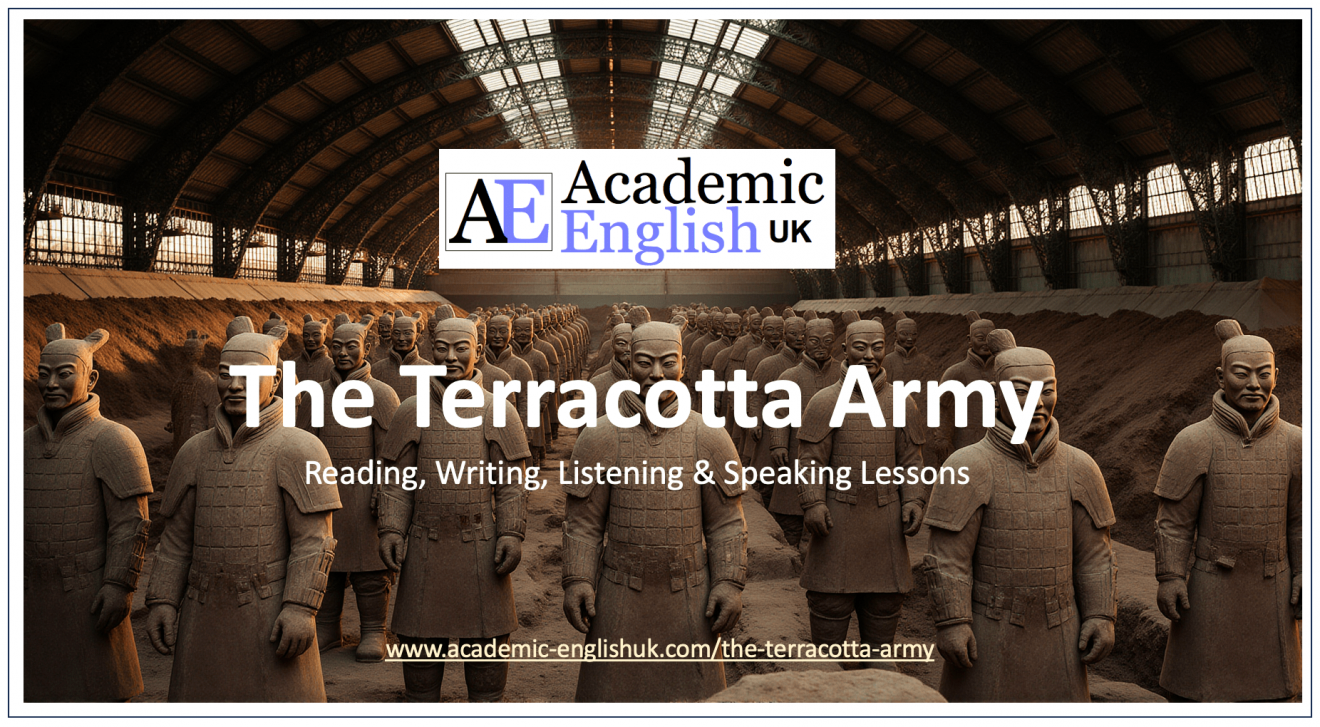
December 2025 The Terracotta Warriors are thousands of life-sized clay soldiers created during the third century BCE to guard the tomb of Qin Shi Huang, the first emperor of a unified China...
|
|
|
|
|
|
English for ART: Vocabulary Workbook
|
|
|
November 2025 "English for Art" refers to specialised English language instruction that develops vocabulary and communication skills relevant to visual arts, art history, and related ....
|
|
|
|
|
|
October 2025. Generative AI (Gen AI) is transforming higher education for better or for worse. This blog post includes an introductory lesson to the benefits and risks of AI and a 14-minute lecture on...
|
|
|
|
|
|
Want more BLOG articles? Go here for all our 2025 blogs...
|
|
|
|
|