|
We are pleased to introduce the AI-Supported Academic Listening 10-Lesson Workbook (includes 20 short listenings), a practical resource designed to help international students develop strong, independent academic listening skills essential for university success.
|
The workbook also supports Academic English teachers, helping them stay ahead in the rapidly evolving landscape of AI use in the classroom.
|
This resource directly complements the AI-Supported Academic Reading (here) and AI-Supported Academic Writing (here) workbooks by developing the listening skills that underpin effective participation in university study. Students learn to follow lecture organisation, recognise emphasis and cohesion, and infer speaker intention; skills that are critical for understanding lectures, seminars and assessment guidance.
|
AI tools are integrated in a carefully controlled and transparent way to support checking, comparison and reflection after listening rather than replace interpretation or independent judgement. This ensures students remain cognitively engaged, build genuine academic listening confidence, and maintain academic integrity. Ideal for EAP, foundation, pre-sessional and undergraduate support programmes.
|
FREE WORKSHEET: LESSON 3: Recognising Organisation and Signposting
|
The AEUK Team
Newsletter #179
|
|
|
|
What is an AI-supported academic listening workbook?
|
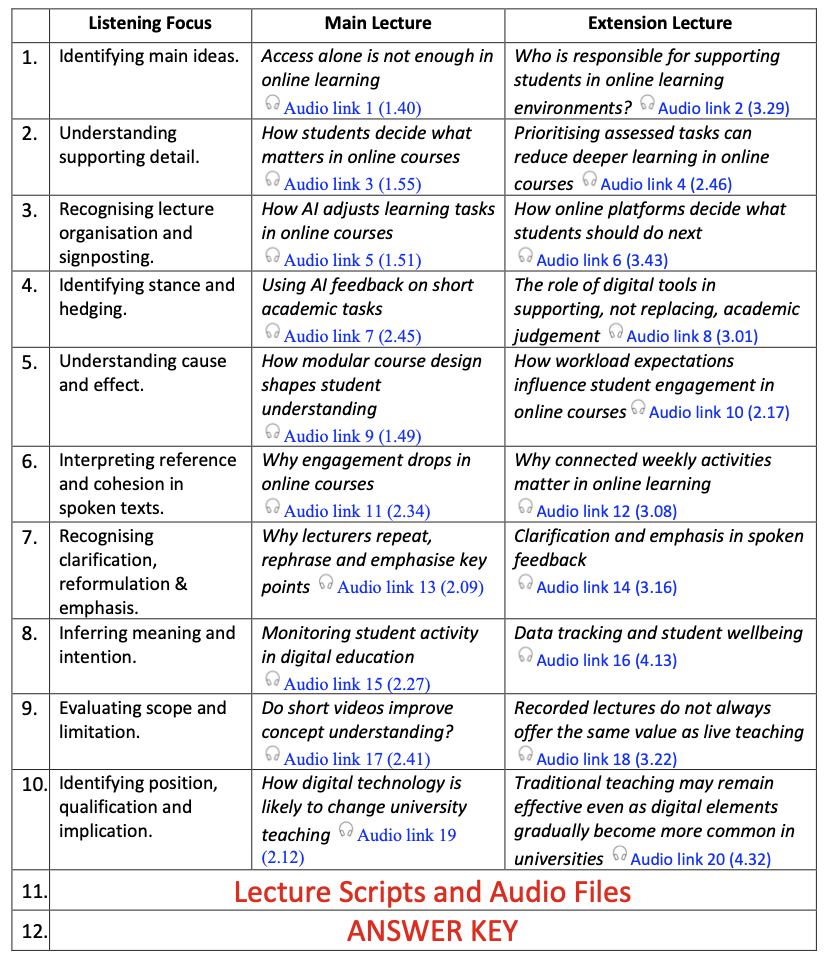
The listening workbook is based on digital learning topics and consists of ten lessons arranged in a clear, structured progression of skills. It moves from identifying main ideas and supporting details to interpreting stance, qualification, and implication in spoken academic lectures, with AI used to support understanding.
|
|
Booklet Contents
|
|
|
|
LESSON 3 EXAMPLE LESSON
Recognising Organisation and Signposting
Aims of the Lesson: By the end of this lesson, you will be able to:
|
- recognise how a short academic lecture is organised.
- dentify signposts used to guide listeners.
- follow the progression of ideas across a spoken explanation.
- compare your understanding of lecture organisation with AI analysis.
|
→ Tip: Focus on how ideas are introduced, developed and concluded, not on individual details.
|
|
→ Note: The theme of this lesson is ‘adaptive task sequencing in AI-supported learning’. No specialist knowledge is needed.
|
|
|
|
Task 1: Pre-listening prediction
Before listening, read the lecture title and predict how the lecture might be organised. Write your answer below.
|
|
Lecture 3: How AI adjusts learning tasks in online courses
|
|
|
|
Task 2: First listening – identifying overall organisation
|
Listen to the mini lecture once. Do not take notes. After listening, decide how the lecture is organised overall. Write your answer in short notes in the following box.
|
|
Lecture 3: How AI adjusts learning tasks in online courses
|
|
|
|
Task 3: Second listening – interpreting signposting through lecture meaning
|
Listen to the mini lecture again and complete the table with signposting language you hear and a brief explanation of what it signals in the lecture
|
| |
Signposting Expression |
Function in the Lecture |
| 1. |
|
|
| 2. |
|
|
| 3. |
|
|
| 4. |
|
|
| 5. |
|
|
|
|
|
Task 4: AI-supported comparison
|
Now use an AI tool to support your learning. Use these exact steps.
|
|
Go to the lecture scripts section at the end of this booklet. Upload the script for this lecture to an AI tool and copy this prompt exactly as it is written and compare your answers.
|
|

|
|
|
|
Today I’m going to talk about how AI is used to adjust learning tasks in online courses, and in particular how this process works in practice.
|
|
So, to begin with, in many online courses today, AI systems are used to adjust learning tasks based on how students perform. Rather than giving every student exactly the same sequence of activities, these systems respond to what learners do over time. In other words, instead of following a fixed pathway, students may actually encounter different tasks depending on their progress.
|
|
Now, how does this work in practice? To start with, these systems collect information about student responses. This might include quiz results, repeated errors, or patterns in how students interact with tasks. Once that data is collected, that information is then analysed to identify areas where a student may need additional support.
|
|
For example, if a learner struggles with a particular concept more than once, the system might offer extra practice tasks or, in some cases, an alternative explanation. By contrast, students who show consistent understanding may move on more quickly to more challenging material.
|
|
Over time, then, what this creates is a personalised sequence of tasks within the same course. All students are still working with the same core content, so the content itself doesn’t change, but the order and emphasis of activities can differ. So, in effect, AI-supported task sequencing is designed to support learning by responding to individual needs, rather than applying a single structure to everyone. And that’s really the key point here.
|
|
Task 5: Feedback
Answer the following questions:
|
- Did the AI describe the lecture organisation in the same way as you? Why or why not?
- Did the AI identify the same signposting language you noticed while listening?
- Why might recognising organisation and signposting be more challenging in spoken lectures than in written texts?
|
|
|
Task 6: Optional extension activity
Listen to the following lecture and take notes how the lecture is organised, the signposting language you identify and what the signposting language signals.
|
|
Optional Lecture: How online platforms decide what students should do next
|
- Apply the strategies you learned in this lesson to compare your answers.
|
|
|
|
|
Downloads
|
|
|
|
|
FREE LISTENING LESSON 3
Recognising lecture organisation and signposting [new 2026]
|
Lesson 3 focuses on helping students recognise how spoken academic lectures are organised and how signposting language guides listeners through explanations. Students should listen for how the speaker introduces the topic and develops it across stages, rather than focusing on individual details. Level: ***** [B1/B2/C1
|
|
|
|
|
|
AI-supported Academic Listening 10-Lesson Workbook
|
The AI-supported listening workbook helps international students develop confident academic listening skills for university study. Lessons progress from identifying main ideas and supporting detail to interpreting stance, qualification and implication in spoken academic lectures, using a neutral theme of education in the digital age. AI tools are used in a controlled way to support checking, reflection and critical evaluation rather than answer generation. LESSON EXAMPLE Level: ***** [B1/B2/C1] Audio Files 1-20 (link in download) / Audio Files Video (link in download) TEACHER MEMBERSHIP / INSTITUTIONAL MEMBERSHIP
|
|
|
|
|
|
|
|
|
|
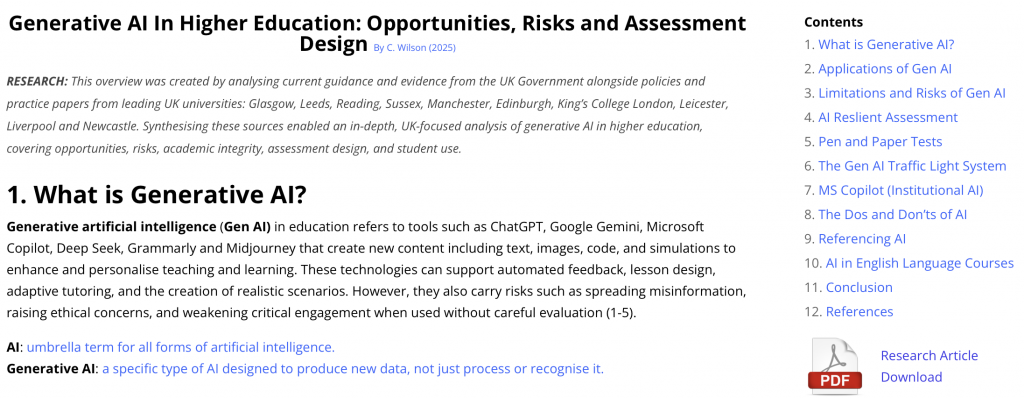
AI in Higher Education Research Article
|
|
|
|
Recent Blog Articles
|
|
|
|
|
AI-Supported Academic Listening
|
|
|
March 2026 AI-Supported Academic Listening Workbook. The listening workbook offers ten lessons on a clear, structured progression of skills, guiding students from identifying main ideas to...
|
|
|
|
|
|
A.I Supported Academic Reading
|
|
|
February 2026 AI-Supported Academic Reading Book. This AI-supported academic reading workbook for international university students focuses on strengthening reading skills...
|
|
|
|
|
|
AI-Supported Academic Writing Workbook
|
|
|
January 2026 AI-Supported Academic Writing Book. This AI-supported academic writing workbook is designed for international university students and develops sentence- and …
|
|
|
|
|
|
Academic English UK Achievements 2025
|
|
|
January 2026 We proudly launched over 70 new resources, expanded our library with engaging YouTube videos, and most importantly received fantastic feedback from our amazing community...
|
|
|
|
|
|
December 2025 The Terracotta Warriors are thousands of life-sized clay soldiers created during the third century BCE to guard the tomb of Qin Shi Huang, the first emperor of a unified China...
|
|
|
|
|
|
English for ART: Vocabulary Workbook
|
|
|
November 2025 "English for Art" refers to specialised English language instruction that develops vocabulary and communication skills relevant to visual arts, art history, and related ....
|
|
|
|
|
|
October 2025. Generative AI (Gen AI) is transforming higher education for better or for worse. This blog post includes an introductory lesson to the benefits and risks of AI and a 14-minute lecture on...
|
|
|
|
|
|
Want more BLOG articles? Go here for all our 2025 blogs...
|
|
|
|
|
|