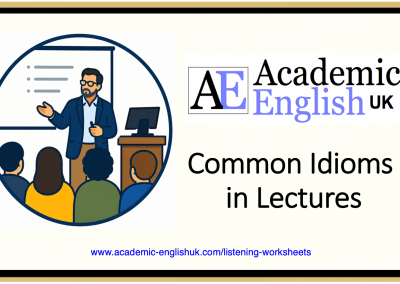
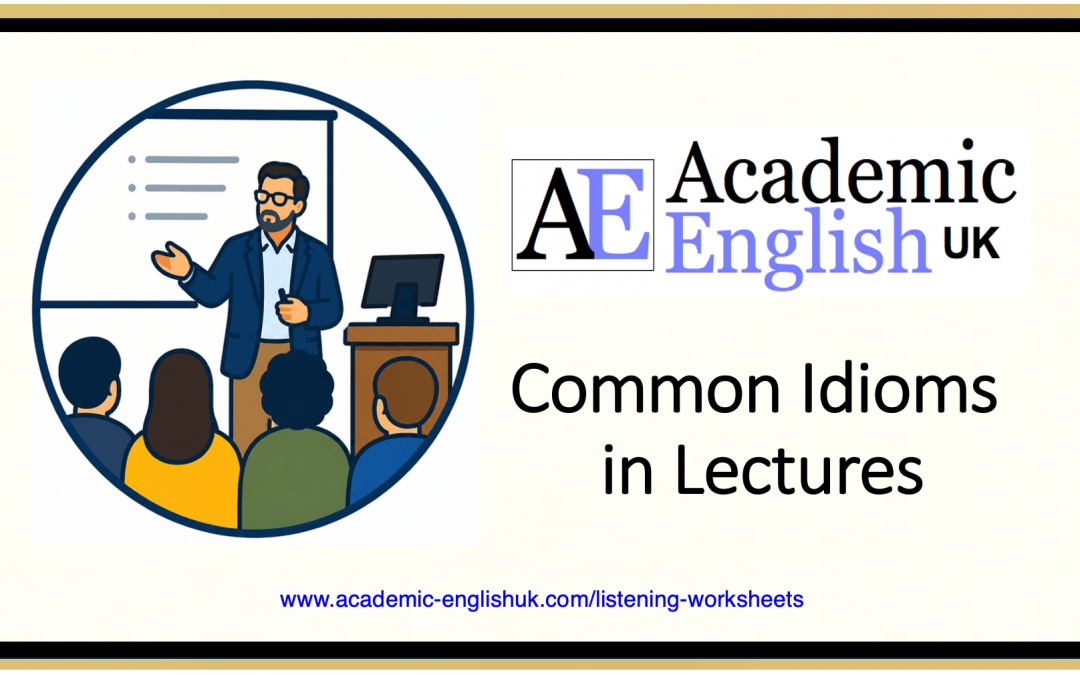
Common Idioms used in Lectures
What is an idiom?
An idiom refers to its meaning as a whole, rather than the meanings of the individual words. In idioms, the literal meanings of the words often do not help you understand the actual meaning.
Example:
|
“It’s a piece of cake” |
“It costs an arm and a leg” |
Idioms are widely used in spoken and informal academic English because they:
- add naturalness → native speakers use them frequently
- make speeches more engaging → they add colour and personality
- condense meaning → a short phrase can express a complex idea
- “Let’s get to the point”= stop wasting time and focus
- “That’s a grey area”= something unclear or uncertain
Examples of Lecture Idioms
Structuring & Signposting the Lecture
- “Let’s start by laying the groundwork…” (We’re starting with the fundamentals)
- “I’ll begin by touching on X, and then dive deeper into Y” (I’ll give a brief overview, then get into details)
- “I’m going to go off on a tangent for a moment, but it’s related…” (I’m making a brief detour from the main point)
Emphasising Importance & Critical Thinking
- “The bottom line is…” (This is the single most important conclusion of this point)
- “Let’s unpack that idea a bit more” (Let’s analyse this concept in detail)
- “It’s a double-edged sword” (There are complexities, trade-offs, or two sides to the issue)
Inviting Engagement & Checking Understanding
- “Are we on the same page?” (Do you understand? Should I explain it again?)
- “This is Food for thought” (Here’s an interesting idea for you to think about on your own)
- “Let me paint you a different picture” (Perfect for introducing a new analogy, especially a visual or more descriptive one)
Referencing Sources & Scholarship
- “The gold standard in this field is…” (The most original and influential study is…)
- “It’s a hotly debated topic” (There is significant disagreement among experts)
- “This is a good rule of thumb” (This is a useful, practical principle that applies in most situations)
Finish a lecture or presentation
- “The take-home message here is…” (Directs the audience to the single most important takeaway or practical conclusion)
- “As a final thought…” (Explicitly frames what an insight you want the audience to retain)
Image Consolidation
Try to guess the idiom from the visual image (there are 20 images in paying download)

“It’s a double-edged sword”
“It’s a hotly debated topic”
“This is a good rule of thumb“
“Let me paint you a different picture”
Speaking Production
Use the idiom to create a spoken sentence. Look at the idiomatic phrase and try to produce a sentence using it. You can choose any topic, but make sure your sentence clearly reflects the meaning of the idiom. There are 24 idiom speaking prompts in paid version.


Common Idioms in Lectures [new 2026]
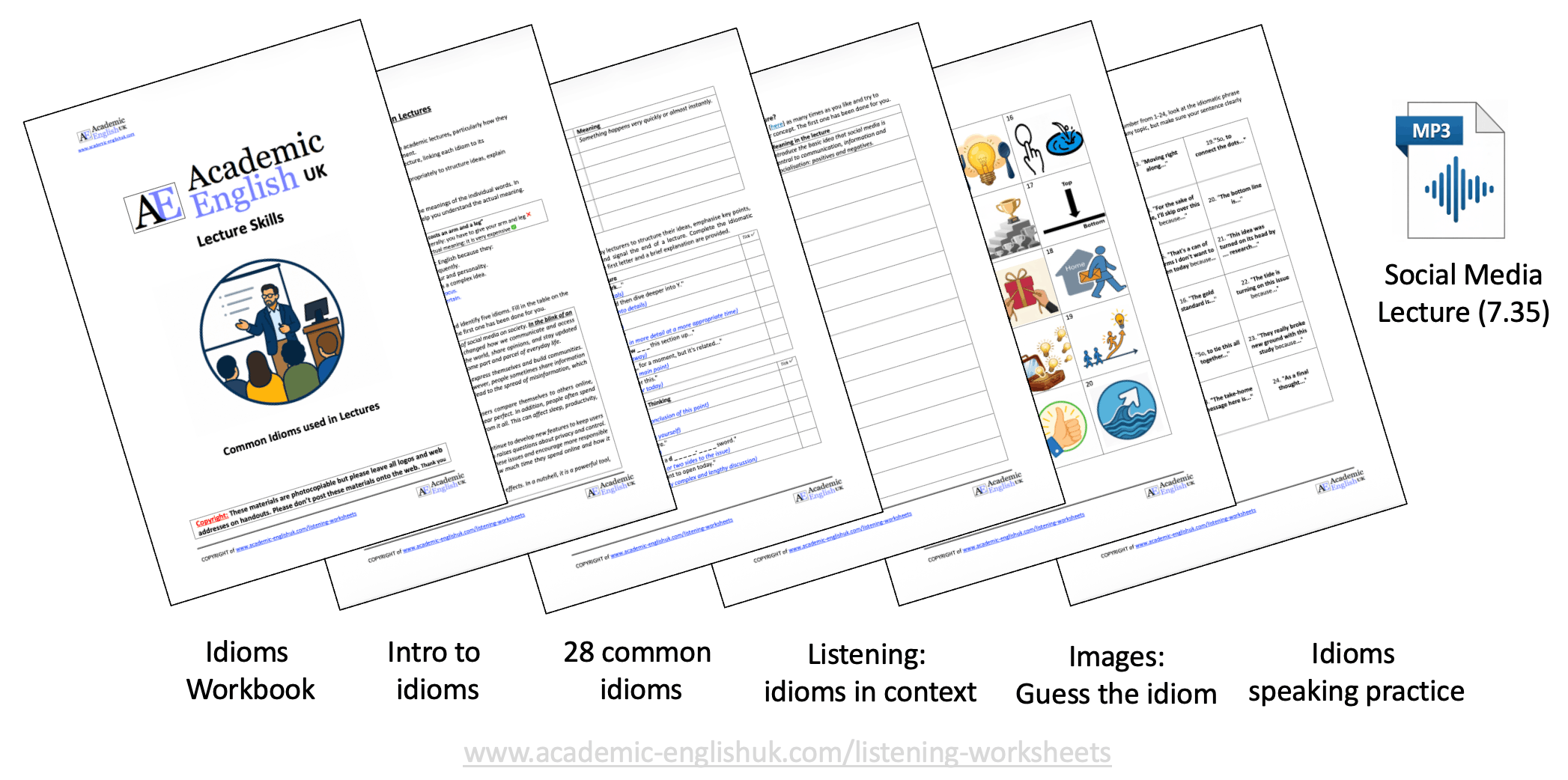
This 22-page workbook helps students recognise and understand idioms in academic spoken English. Using authentic lecture extracts and structured listening tasks, it covers idioms for signposting, emphasis, critical thinking, audience engagement, referencing scholarship, and concluding presentations.Activities progress from identifying and interpreting idioms in context, to analysing their use in a 8-minute social media lecture, to applying them in speaking tasks. Full transcripts and answer keys are included for classroom or independent study (Example) Level: *****[B1/B2/C1]. Lecture MP3 / Video (in paying Download). TEACHER MEMBERSHIP / INSTITUTIONAL MEMBERSHIP
Social Media Lecture
This is just a sample of a short lecture (7.40) on the five most common negative effects of social media
If you can’t access this YouTube video in your country, go here
Social Media Lecture: The five most common issues with social media [new 2026]
This 8-minute lecture by Prof. Imogen Smith examines the five most common issues with social media (misinformation, echo chambers, binge scrolling, mental health, and attention span). It includes an academic lecture with structured note-taking or PPTs, comprehension questions, and critical thinking prompts. (Worksheet Example / Video Example) Level: *****[B1/B2/C1]. MP3 / Video / PPT Slides (available in paying download) TEACHER MEMBERSHIP / INSTITUTIONAL MEMBERSHIP
Idiom Workbook Download
Common Idioms in Lectures [new 2026]
This 22-page workbook helps students recognise and understand idioms in academic spoken English. Using authentic lecture extracts and structured listening tasks, it covers idioms for signposting, emphasis, critical thinking, audience engagement, referencing scholarship, and concluding presentations.Activities progress from identifying and interpreting idioms in context, to analysing their use in a 8-minute social media lecture, to applying them in speaking tasks. Full transcripts and answer keys are included for classroom or independent study (Example) Level: *****[B1/B2/C1]. Lecture MP3 / Video (in paying Download). TEACHER MEMBERSHIP / INSTITUTIONAL MEMBERSHIP