AI-Supported Academic Listening Workbook
What is the AI-Supported Academic Listening Workbook?
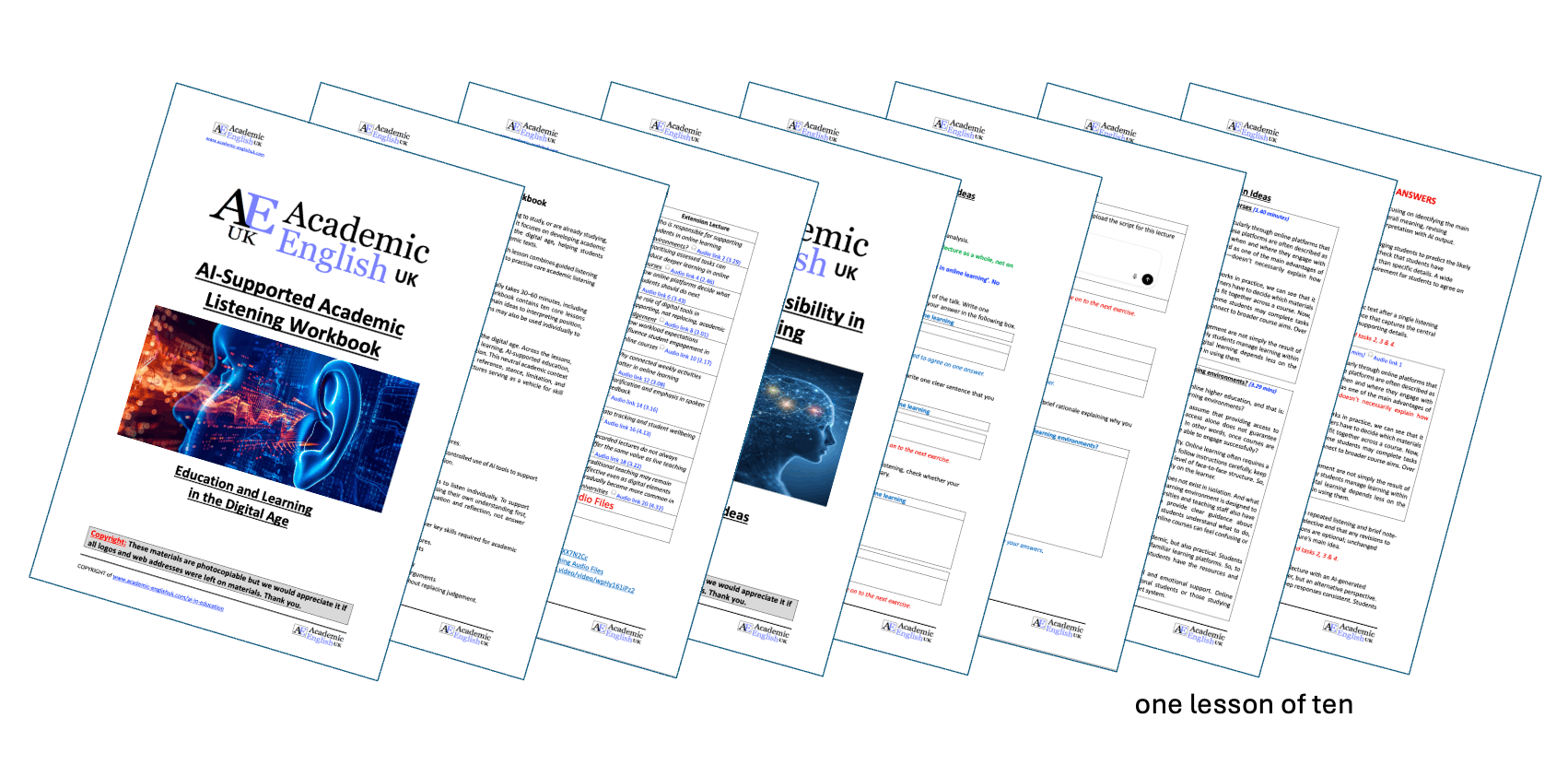
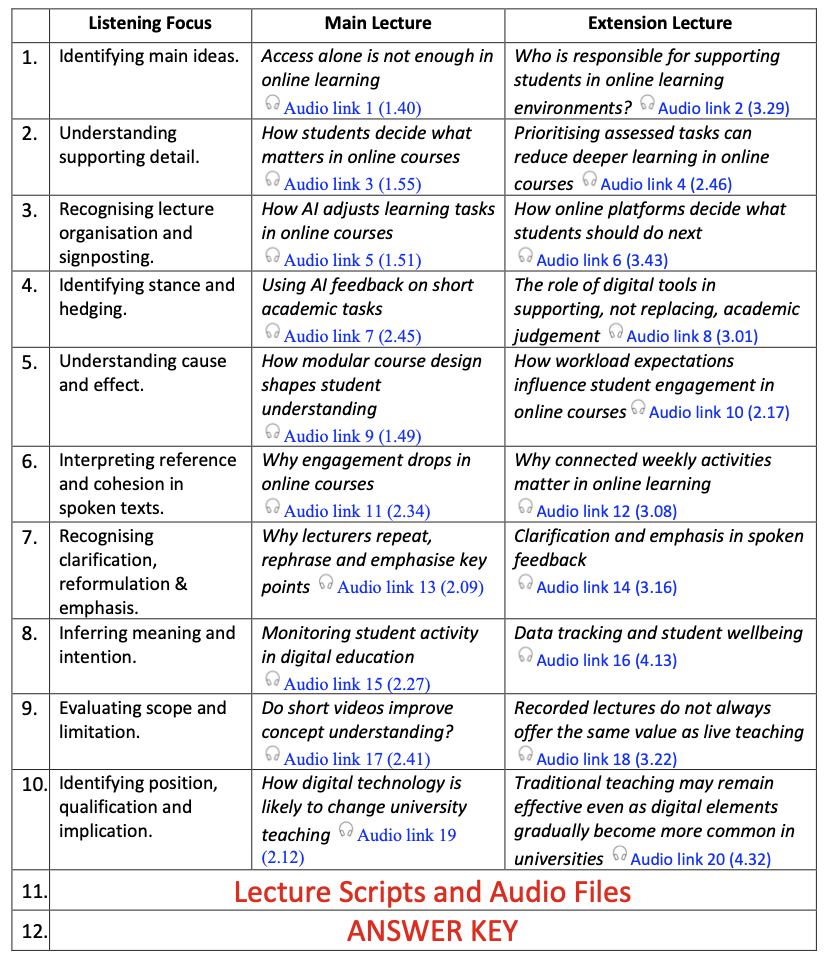
The listening workbook offers ten lessons on a clear, structured progression of skills, guiding students from identifying main ideas and supporting details to interpreting stance, qualification, and implication in spoken academic lectures. Built around neutral academic themes related to education in the digital age, it allows learners to focus on how academic listening works rather than on specialist subject knowledge. Integrated AI tools help check and reinforce understanding of key concepts and ideas.
Booklet Content
Lesson Downloads
FREE LISTENING LESSON 3: Recognising lecture organisation and signposting [new 2026]
Lesson 3 focuses on helping students recognise how spoken academic lectures are organised and how signposting language guides listeners through explanations. Students should listen for how the speaker introduces the topic and develops it across stages, rather than focusing on individual details. Level: ***** [B1/B2/C1] Audio File 5 / Audio File 6 TEACHER MEMBERSHIP / INSTITUTIONAL MEMBERSHIP
AI-supported Academic Listening 10-Lesson Workbook [new 2026]
The AI-supported listening workbook helps international students develop confident academic listening skills for university study. Lessons progress from identifying main ideas and supporting detail to interpreting stance, qualification and implication in spoken academic lectures, using a neutral theme of education in the digital age. AI tools are used in a controlled way to support checking, reflection and critical evaluation rather than answer generation. LESSON EXAMPLE Level: ***** [B1/B2/C1] Audio Files 1-20 (link in download) / Audio Files Video (link in download) TEACHER MEMBERSHIP / INSTITUTIONAL MEMBERSHIP
How to use AI to support academic lecture listening
A short lecture on using AI as a support tool in listening rather than just asking it for answers.
If you can’t access this YouTube video in your country, go here
Worksheet Download: click here
EXAMPLE LISTENING LESSON
Lesson 3: Recognising Organisation and Signposting
Aims of the Lesson
By the end of this lesson, you will be able to:
- recognise how a short academic lecture is organised.
- identify signposts used to guide listeners.
- follow the progression of ideas across a spoken explanation.
- compare your understanding of lecture organisation with AI analysis.
Tip:Focus on how ideas are introduced, developed and concluded, not on individual details.
Note: The theme of this lesson is ‘adaptive task sequencing in AI-supported learning’. No specialist knowledge is needed.
Task 1: Pre-listening prediction
Before listening, read the lecture title and predict how the lecture might be organised. Write your answer in the following box.
|
Lecture 3: How AI adjusts learning tasks in online courses |
| Your Answer |
|
|
Task 2: First listening – identifying overall organisation
Listen to the mini lecture once. Do NOT take notes. After listening, decide how the lecture is organised overall. Write your answer in short notes in the following box.
| Lecture 3: How AI adjusts learning tasks in online courses |
| Your Answer |
Task 3: Second listening – interpreting signposting through lecture meaning
Listen to the mini lecture again and complete the table with the signposting language you hear and a brief explanation of what it signals in the lecture. Do NOT copy full sentences from the lecture. 🎧 Audio link 5
| Signposting Expression | Function in the Lecture | |
| 1. | ||
| 2. | ||
| 3. | ||
| 4. | ||
| 5. |
Task 4: AI-supported comparison
Now use an AI tool to support your learning. Use these exact steps.
1.Go to the lecture scripts section at the end of this booklet. Upload the script for this lecture to an AI tool and copy this prompt exactly as it is written:

2. Compare the AL’s answers with yours.
Task 5: Feedback
Answer the following questions:
| 1. |
Did the AI describe the lecture organisation in the same way as you? Why or why not?
|
|
| 2. |
Did the AI identify the same signposting language you noticed while listening?
|
|
| 3. | Why might recognising organisation and signposting be more challenging in spoken lectures than in written texts? |
Task 6: Optional extension activity
Listen to the following lecture and take notes how the lecture is organised, the signposting language you identify and what the signposting language signals.
| How online platforms decide what students should do next |
|
Notes
|
- Apply the strategies you learned in this lesson to compare your answers.
AI-Supported Academic Listening 10-Lesson Workbook
FREE LISTENING LESSON 3: Recognising lecture organisation and signposting [new 2026]
Lesson 3 focuses on helping students recognise how spoken academic lectures are organised and how signposting language guides listeners through explanations. Students should listen for how the speaker introduces the topic and develops it across stages, rather than focusing on individual details. Level: ***** [B1/B2/C1] Audio File 5 / Audio File 6 TEACHER MEMBERSHIP / INSTITUTIONAL MEMBERSHIP
AI-supported Academic Listening 10-Lesson Workbook [new 2026]
The AI-supported listening workbook helps international students develop confident academic listening skills for university study. Lessons progress from identifying main ideas and supporting detail to interpreting stance, qualification and implication in spoken academic lectures, using a neutral theme of education in the digital age. AI tools are used in a controlled way to support checking, reflection and critical evaluation rather than answer generation. LESSON BOOK EXAMPLE Level: ***** [B1/B2/C1] Audio Files 1-20 (link in download) / Audio Files Video (link in download) TEACHER MEMBERSHIP / INSTITUTIONAL MEMBERSHIP
AI-Supported Academic Reading 10-Lesson Workbook
FREE READING LESSON 4: Recognising writer’s stance and hedging [new 2026]
Lesson 4 focuses on recognising a writer’s stance in academic texts, including whether a position is positive, cautious, or critical. Students identify common hedging language and learn to distinguish between strong claims and cautious academic claims using short digital-learning texts, supporting more critical reading in later lessons. Level: ***** [B1/B2/C1] TEACHER MEMBERSHIP / INSTITUTIONAL MEMBERSHIP
AI-supported Academic Reading 10-Lesson Workbook [new 2026]
The AI-supported academic reading workbook helps international students develop core academic reading skills for university study. Lessons move from sentence-level understanding to paragraph and text analysis, using neutral academic themes linked to digital education. Students practise identifying main ideas, supporting details, reference, cohesion, and stance. AI tools are used in a controlled way to support checking and reflection rather than replace reading, supporting accurate comprehension, critical reading, and academic judgement. LESSON BOOK EXAMPLE Level: ***** [B1/B2/C1] TEACHER MEMBERSHIP / INSTITUTIONAL MEMBERSHIP
AI-Supported Academic Writing 10-Lesson Workbook
FREE LESSON 1: Sentence Accuracy – Identifying Errors [new 2026]
Lesson 1 focuses on developing sentence-level grammatical accuracy, particularly subject–verb agreement and singular/plural nouns, using short academic sentences on digital learning as practice. It introduces controlled use of AI to help students check and reflect on their own corrections, laying the foundation for the remaining lessons in the ten-lesson sequence. Level: ***** [B1/B2/C1] TEACHER MEMBERSHIP / INSTITUTIONAL MEMBERSHIP
AI-supported Academic Writing 10-Lesson Workbook [new 2026]
The AI-Supported Writing Workbook helps international students develop clear, accurate academic writing for university study. Lessons progress from sentence-level accuracy to paragraph-level writing, using a neutral academic theme focused on education in the digital age. AI tools are used in a controlled way to support checking, reflection and critical evaluation rather than content generation. LESSON BOOK EXAMPLE. Level: ***** [B1/B2/C1] TEACHER MEMBERSHIP / INSTITUTIONAL MEMBERSHIP
Research Paper
Generative AI In Higher Education: Opportunities, Risks and Assessment Design By C. Wilson (2025)
RESEARCH: This overview was created by analysing current guidance and evidence from the UK Government alongside policies and practice papers from leading UK universities: Glasgow, Leeds, Reading, Sussex, Manchester, Edinburgh, King’s College London, Leicester, Liverpool and Newcastle. Synthesising these sources enabled an in-depth, UK-focused analysis of generative AI in higher education, covering opportunities, risks, academic integrity, assessment design, and student use.
1. What is Generative AI?
Generative artificial intelligence (Gen AI) in education refers to tools such as ChatGPT, Google Gemini, Microsoft Copilot, Deep Seek, Grammarly and Midjourney that create new content including text, images, code, and simulations to enhance and personalise teaching and learning. These technologies can support automated feedback, lesson design, adaptive tutoring, and the creation of realistic scenarios. However, they also carry risks such as spreading misinformation, raising ethical concerns, and weakening critical engagement when used without careful evaluation (1-5).
AI: umbrella term for all forms of artificial intelligence.
Generative AI: a specific type of AI designed to produce new data, not just process or recognise it.
More AI Lesson Downloads
AI Lecture Listening Test Worksheet [new 2025]
This listening lecture lesson examines how generative AI is reshaping higher education by exploring its opportunities, risks, and implications for assessment design. Students take notes using the PPT slide and then answer a range of questions: open, matching, multiple-choice, and critical thinking. EXAMPLE Level *****[B2/C1] VIDEO [14.30] / MP3 / PPT link in download / TEACHER MEMBERSHIP / INSTITUTIONAL MEMBERSHIP
An Introduction to AI in the Classroom [new 2025]
This lesson introduces students to the key opportunities, risks, and ethical considerations of using generative AI in higher education. Through reading, writing, and discussion tasks, students learn how to apply AI responsibly, evaluate its limitations, and understand institutional policies such as the AI Traffic Light System for academic integrity. EXAMPLE Level ***** [B1/B2/C1] WEBPAGE TEACHER MEMBERSHIP / INSTITUTIONAL MEMBERSHIP
AI Student Checklist [new 2025]
This Student AI Checklist helps learners use generative AI safely, ethically, and within university guidelines. It is important because it promotes academic integrity, protects personal data, and ensures students remain responsible for their own understanding and original work. Level ***** [B1/B2/C1] INFORMATION WEBPAGE TEACHER MEMBERSHIP / INSTITUTIONAL MEMBERSHIP
TED TALK: AI in the Real World
How AI will step off the screen and into the real world – Daniela Russ (2024)
This inspirational TED talk discusses how the convergence of AI and robots will unlock a wonderful world of new possibilities in everyday life. The listening tests includes multiple choice, short answer questions, sentence completion, table completion and summary completion. Example. Level: ***** [B1/B2/C1] / Video [12:54] TEACHER MEMBERSHIP / INSTITUTIONAL MEMBERSHIP
TED TALK: Losing Control of A.I
Losing control of Artificial Intelligence (AI)? Sam Harris
TED Talk: An informative talk about the worries of A.I and how we fail to address the seriousness of what A.I could become. Listening worksheets use a range of test type questions (T/F/NG, open questions, information gap fills, table completion, summaries, etc..). Example of test Level: ***** [C1] / Video [14:27] TEACHER MEMBERSHIP / INSTITUTIONAL MEMBERSHIP
TED TALK: A.I Save Humanity
How can A.I save humanity? – Kai Fu Lee
TED TALK: This lecture discusses how China has embraced A.I technology and is accelerating its advancement. It focuses on the main challenges that we all face with an A.I future and how it will positively compliment our lives.The lesson includes teacher’s notes, comprehension questions, critical thinking questions and an answer key. Example. Level: ***** [B2/C1] / Video [14:42] TEACHER MEMBERSHIP / INSTITUTIONAL MEMBERSHIP